Description
If you are employed in a state that uses a registry to track professional development hours, you will be able to provide your registry ID (Stars, MOPID, Registry or other ECE ID#) after you have completed the quiz for the course. If you pass the quiz we will report your course completion to the state registry using the registry ID that you provide.
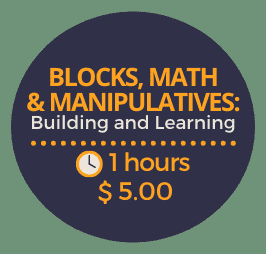
Explore the purpose and potential of block, math, and manipulative centers in early childhood classrooms. Designed for early childhood professionals working with infants through school-age children, this online, self-paced course examines the similarities and differences among these learning areas, appropriate materials for each, and strategies for combining or separating centers. Participants will discover engaging, developmentally appropriate activities that foster problem-solving, creativity, mathematical thinking, spatial awareness, and inclusive play for all children. Course length – 1.0 hour.
The course answers the following questions:
-
What materials should be in the blocks center?
-
What materials should be in the math center?
-
What materials should be in the manipulatives center?
-
What is the difference between a block and a manipulative?
-
How can I get more girls to enjoy the block center?
-
Should the centers be combined and if so, in what ways will that work?
-
What are some great activities for these centers for MY age group?
Participants who successfully complete this course will be able to:
-
Identify the essential materials commonly found in block, math, and manipulative centers with 90% accuracy on the course assessment.
-
Differentiate between block, math, and manipulative materials by correctly classifying at least 15 classroom materials according to their primary purpose.
-
Evaluate the advantages and considerations of combining or separating block, math, and manipulative centers in early childhood classrooms.
-
Select at least five developmentally appropriate activities that promote problem-solving, spatial reasoning, mathematical thinking, and fine motor development within these learning centers.
-
Develop an inclusive plan for organizing block, math, and manipulative centers that encourages participation, including strategies for increasing engagement among children with diverse interests and abilities.