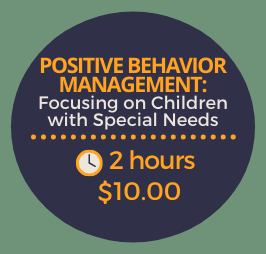
Positive Behavior Management: Focusing on Children with Special Needs
If you are employed in a state that uses a registry to track professional development hours, you will be able to provide your registry ID (Stars, MOPID, Registry or other ECE ID#) after you have completed the quiz for the course. If you pass the quiz we will report your course completion to the state registry using the registry ID that you provide.
Gain a foundational understanding of the differences between challenging behaviors and behaviors that may result from special needs or unmet developmental needs. Designed for early childhood educators, this course explores sensory processing disorder, autism, dyslexia, executive functioning disorder, trauma, self-regulation, and proprioception. Through practical instruction and real-world examples, participants will learn to better recognize children’s needs and respond with understanding, appropriate support, and effective strategies. Course length – 2.0 hours.
This course helps answer the following questions:
-
What is sensory processing disorder?
-
What is autism?
-
What is dyslexia?
-
What is executive functioning disorder?
-
How can trauma affect children?
-
What are self-regulation problems?
-
What is proprioception?
-
How can I help children dealing with these issues?
Participants who successfully complete this course will be able to:
-
Identify at least three common special needs that may be encountered in an early childhood setting with 80% accuracy on the course assessment.
-
Recognize at least three signs that may indicate a child could benefit from further developmental evaluation.
-
Develop a support plan that includes at least three appropriate classroom strategies and two available resources for supporting a child with special needs.
