Description
If you are employed in a state that uses a registry to track professional development hours, you will be able to provide your registry ID (Stars, MOPID, Registry or other ECE ID#) after you have completed the quiz for the course. If you pass the quiz we will report your course completion to the state registry using the registry ID that you provide. This is a child care course about autism.
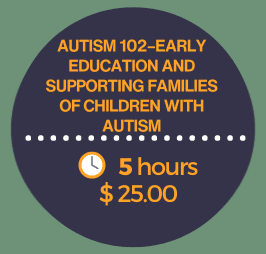
Build your knowledge of Autism Spectrum Disorder (ASD) by exploring practical, evidence-based strategies for supporting children with autism in early childhood settings. Designed for early care and education professionals who have completed Autism 101 or have foundational knowledge of ASD, this online, self-paced course focuses on strengthening family partnerships, preparing inclusive classroom environments, implementing effective teaching practices, and preventing challenging behaviors to promote positive outcomes for every child. Course length – 5.0 hours.
The course helps answer the following questions:
-
What is Autism?
-
Why is early intervention important?
-
How can I build partnerships with the families?
-
How can I best prepare my classroom for children with Autism?
-
What are some strategies for preventing undesirable behaviors?
By the end of this course, participants will be able to:
-
Explain the role of early intervention and evidence-based practices in supporting children with Autism Spectrum Disorder (ASD) with 90% accuracy on the course assessment.
-
Identify at least five strategies for creating an inclusive classroom environment that supports the learning and participation of children with ASD.
-
Describe at least four effective practices for building respectful, collaborative partnerships with families of children with ASD.
-
Select at least four evidence-based strategies to prevent or reduce challenging behaviors in children with ASD through positive guidance and environmental supports.
-
Develop an action plan for implementing at least three classroom strategies that support the communication, engagement, and success of children with ASD in early learning environments.