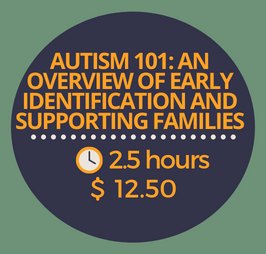
Autism 101: An Overview of Early Identification and Supporting Families
If you are employed in a state that uses a registry to track professional development hours, you will be able to provide your registry ID (Stars, MOPID, Registry or other ECE ID#) after you have completed the quiz for the course. If you pass the quiz we will report your course completion to the state registry using the registry ID that you provide.
Learn how to recognize the early signs of Autism Spectrum Disorder (ASD) and developmental delays while supporting children and their families with confidence and compassion. Designed for early childhood professionals, this online, self-paced course explores indicators of atypical development, effective communication with families, the importance of early intervention, and common co-occurring medical conditions. Participants will gain practical strategies for identifying concerns, responding appropriately, and fostering positive partnerships that promote the best outcomes for children. Course length – 2.5 hours.
The course will help answer the following questions:
-
What does autism spectrum really mean?
-
What are some indicators I may notice different from a typically developing child?
-
How should I approach a parent if I notice these indicators?
-
Why is early intervention important?
-
What are some common co-occurring medical conditions?
By the end of this course, participants will be able to:
-
Define Autism Spectrum Disorder (ASD) and explain the meaning of the autism spectrum with 90% accuracy on the course assessment.
-
Identify at least five early indicators of ASD or developmental delays that differ from typical developmental milestones.
-
Describe at least three best practices for communicating developmental concerns with families in a respectful, supportive, and professional manner.
-
Explain the importance of early identification and early intervention by identifying at least three benefits for children and families.
-
Recognize at least four common co-occurring medical conditions associated with ASD and explain how they may affect a child’s development and participation in early learning environments.
