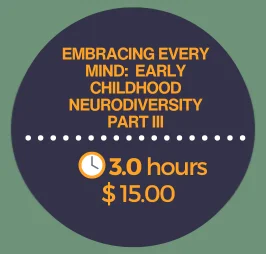
Embracing Every Mind: Early Childhood Neurodiversity Part III
If you are employed in a state that uses a registry to track professional development hours, you will be able to provide your registry ID (Stars, MOPID, Registry or other ECE ID#) after you have completed the quiz for the course. If you pass the quiz we will report your course completion to the state registry using the registry ID that you provide.
Explore the foundations of neurodiversity and gain a deeper understanding of the unique ways children learn, think, and interact. Designed for early childhood educators, this self-paced online course examines common neurodevelopmental profiles, including ADHD, social anxiety, dyscalculia, and masking. Participants will develop practical strategies for recognizing individual strengths and challenges while creating more inclusive, supportive learning environments that help every child thrive. Course length – 3.0 hours.
The course helps answer the following questions:
-
What is ADHD?
-
What is Social Anxiety?
-
What is Dyscalculia?
-
What is Masking?
Participants who successfully complete this course will be able to:
-
Define neurodiversity and identify at least three of its core concepts with 80% accuracy on the course assessment.
-
Identify at least three strengths and three possible support needs of neurodivergent children in early childhood settings.
-
Select at least three strengths-based classroom practices that recognize and build upon children’s individual abilities.
-
Identify common characteristics of neurodevelopmental conditions and determine when additional evaluation or support may be appropriate.
