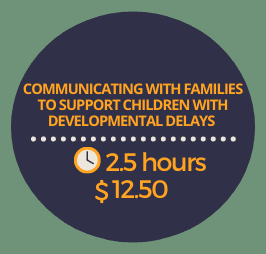
Communicating with Families to Support Children with Developmental Delays
If you are employed in a state that uses a registry to track professional development hours, you will be able to provide your registry ID (Stars, MOPID, Registry or other ECE ID#) after you have completed the quiz for the course. If you pass the quiz we will report your course completion to the state registry using the registry ID that you provide.
Develop the knowledge and confidence to communicate with families about developmental concerns in this online, self-paced course designed for early childhood professionals. Learn strategies for building trusting relationships, discussing possible developmental delays with sensitivity, and connecting families with appropriate community and state resources. Through practical guidance and real-world examples, you will strengthen communication skills, support families effectively, and promote timely access to services for children who may need additional support. Course length – 2.5 hours.
The course helps answer the following questions:
-
How do I establish good communication with families from day one?
-
What should I do if I believe a child in my care may have a developmental delay?
-
How should I approach family members if I have a concern that their child may have a developmental delay?
-
How can I advocate for families while they are going through the process of seeking help for their child?
Participants who successfully complete this course will be able to:
-
Identify at least three strategies for establishing and maintaining positive relationships with families with 80% accuracy on the course assessment.
-
Select at least three effective communication strategies for discussing sensitive topics, including developmental concerns, with families.
-
Develop a family-partnership plan that includes at least three ways to connect families with the program, other caregivers, and community or state resources.
