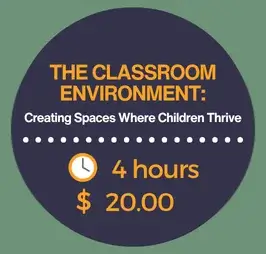
The Classroom Environment: Creating Spaces Where Children Thrive
If you are employed in a state that uses a registry to track professional development hours, you will be able to provide your registry ID (Stars, MOPID, Registry or other ECE ID#) after you have completed the quiz for the course. If you pass the quiz we will report your course completion to the state registry using the registry ID that you provide.
Explore how the early childhood classroom environment influences children’s behavior, independence, engagement, relationships, and development. Learn practical strategies for designing calm, welcoming, organized, and purposeful spaces. Discover ways to arrange learning areas, support children’s independence, reduce clutter and overstimulation, and make the most of small spaces. Examine how thoughtfully designed indoor and outdoor environments encourage exploration, meaningful interactions, and learning. Course length – 4.0 hours.
The course helps answer the following questions:
-
How does the classroom environment influence children’s learning, behavior, independence, and emotional well-being?
-
What makes a learning space calm, welcoming, accessible, and developmentally appropriate?
-
How can classroom arrangement and organization support children’s independence and engagement?
-
How can educators reduce clutter and overstimulation while making the most of small spaces?
-
How can indoor and outdoor environments encourage exploration, relationships, and meaningful learning?
Participants who successfully complete this course will be able to:
-
Explain at least three ways the classroom environment can influence children’s learning, behavior, independence, and emotional well-being.
-
Identify at least four environmental design strategies that create calm, inviting, accessible, and developmentally appropriate learning spaces.
-
Apply classroom organization, arrangement, and decluttering strategies to improve the function of an early childhood learning environment.
